Aragami Review

Aragami Review

First 15

The game opens into a hazy cutscene showing me something I’m sure is important, but without any sort of context I can’t tell what it’s supposed to mean.

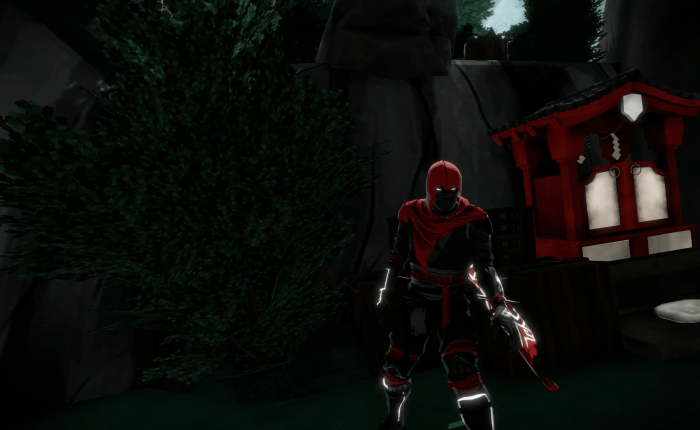
Now I’m into the normal game, and it looks absolutely beautiful. The environment, the main character, everything looks stylized and yet realistic at the same time.

The game drops me right into it and quickly walks through teaching me how to use my abilities. The game also teaches me about being in shadow and to avoid the light.

The way they shows me what buttons to use is really neat. There are giant tablets in the world that have the instructions written on them. Surprisingly, it feels quite natural.

The audio is interesting. The dialogue is in, I think, Japanese but it’s run through an audio filter so it sounds a little like characters are talking underwater. It reminds me of Okami. Of course there’s a lot about this game that reminds me of Okami, which I can only think is a good thing.

I finally got caught out, and discovered that not only do I die in a hit, but the soldiers with swords can use them to fire a wave of light to hit me from range.

After a little more trial and error, I found that once spotted I have a second or two to respond before an enemy either kills me or blows a horn to summon reinforcements.

Story

The character Aragami is a conjured shadow of vengence meant to exact death to the enemies of the princess and to free her from her confinement. One interesting thing about this setup is it completely bypasses the discussion about the morality of killing people. You were summoned to kill the Kaiho, the army of light, and so that is what you’re going to do. The story does go much deeper as you progress, but if I try to describe it then I’ll end up spoiling it.

The reversal of light and dark is also interesting since you are the creature of shadow and your enemies are the army of light. Even the gameplay supports this since shadows are good and light is bad.

Interface

Aragami is a beautiful game, and part of that is the lack of a UI for most of the game. Rather than have a HUD, the designers placed everything the player needs to know on Aragami’s cape, similar to Dead Space. For the most part this works well, though occasionally I had trouble seeing how many special ability charges I had whenever the cape got twisted up.

I wish the camera didn’t auto-rotate to point towards the objective when I push C to have Korasu show me the objectives. Often times I would bring up the indicators so that I could look for ability scrolls, which meant I first had to drag the camera away from the goal marker before I could look around me. They need to add the ability to toggle the auto-rotate off in the options menu.

I like that each of the special abilities has its own charges. This encourages players to make use of the more unique abilities since if they don’t then the charges will simply go to waste.

I found it strange that the game uses (at least on the computer) E for special and F for use. In most other games E is the use key and F is the special key (or melee key in most shooters). A number of times I found myself hitting E to use something, then had to take a moment to remember that F is use. Most of the time I had Kunai equipped so mistakenly hitting E didn’t cost me anything. But I could certainly see people wasting a special ability charge by mistake if they’re used to the keys being reversed. Unfortunately there’s no way to remap the controls.

I wish there was a way to know if I killed all of the guards in a level before I leave since that is one of the optional objectives. I ended one of the levels having missed two guards. I missed those last two guards not because I thought they would be too difficult, but simply because I didn’t know that I had passed by them.

Occasionally you’ll get a checkpoint right before a cutscene (instead of right after it), which is odd. But since you can skip cutscenes, it’s really just a minor annoyance.

Gameplay

Aragami is overpowered. The game goes out of its way to give you some insanely powerful abilities. Not only can you teleport around from shadow to shadow, but you can also create shadows almost anywhere and then teleport to that spot. And then there’s all of the other abilities like the kunai which is a ranged instant kill that never misses. Despite this, you are still going to get killed/spotted. The end result is that whenever you do fail, it absolutely feels like your own fault rather than the game doing something cheap. After all, with such powerful abilities, there should be no reason for you to fail. I feel like this is the real secret to the game that makes the gameplay feel so good.

My one big complaint with the game is that there’s aren’t enough checkpoints in the early levels. Each level is divided up into several areas. In a stealth game such as Aragami, each area is like a puzzle. You keep working at it, learning where enemies are, where they patrol, what areas you have access to, the best places to lure enemies to in order to take them out, until eventually you find the right combination of patience and action to solve the puzzle. The problem is, once you solve a puzzle, it becomes far less interesting having to solve it a second time. You would think that there would be a checkpoint after each area, but often you have to clear through two or even three areas before you reach a checkpoint. This can lead to a situation where you clear the first area, only to fail in the second area and thus have to re-clear the first area. Each time you have to re-clear an area, your enjoyment of that area goes down. The most times I had to clear an area was three times (meaning I died twice in the next area), but after the third time I honestly hated the first area since it took a while to clear and wasn’t interesting at all since I already knew exactly how to solve it. I would like to see the developers be a little more liberal with their checkpoints.

I feel like a lot of stealth games do this and yet every time I see it I cannot help but think it is a mistake. That is, they give the character the ability to go invisible. I feel like granting invisibility to players is a poor design decision because it allows them to go into a state where they no longer have to care about anything. The enemies stop being dangerous, players don’t care if they’re out in the open, and all around it undermines the very foundation of the game itself. Aragami is not the only game to fall into this trap. Deus Ex: Mankind Divided did the same thing, and that too I felt was a bad design decision. I tried out the stealth ability in Aragami and felt that it actually subtracted from the gameplay rather than enhanced it. After my test I decided to continue on as if the invisibility special ability didn’t exist, and I think I enjoyed the game more as a result. I personally would like to see this ability get removed completely. Though the designers would need to double check that each mission can be cleared without killing any enemies (one of the optional objectives) without the use of invisibility.

The ability to disappear corpses should be part of the base kit for Aragami. It’s one of those abilities that has such a massive impact on the game it seems like it’s too important to be considered optional. As for the ability itself, I do like that it doesn’t work on the corpses of enemies that die in direct light. It adds an extra bit of strategy to killing. Though once players gain access to the Shadow Kill special ability, they can use that instead since that ability does work in direct light.

Conclusion

You will like this game if you’re a fan of stealth games. The gameplay is solid, the levels are well laid out, and there’s a constant sense of danger as you go (so long as you play without using the invisibility special ability).

You will not like this game if you aren’t very patient and want a game with a lot of action. You spend a lot of time slinking around in the shadows, and if you get killed then you will have to repeat a bit to get back to where you were.

Aragami is an incredibly well made game. I know I’ve said this already but I can’t say enough about how beautiful the game is. The aesthetics make you want to explore the world, while the solid gameplay will make you truly feel like a master assassin. Aragami is one of those games that takes a core idea, stealth assassin, and successfully narrows down the mechanics to deliver a near perfect game.
Song of the Deep Review

Song of the Deep Review

The First 15

I chose intermediate difficulty.

A very big part of this game will be the strength of its art. So far all of the artwork is beautiful and if the game maintains this level of talent than I will be very impressed.

The story is told as if the player were being read to from a storybook. The format works very well and meshes nicely with the art style. That is except for one massively glaring plot hole, which I’ll go over in more detail in the story section of my review.

Moving through the kelp causes it to glow. This is both visually appealing to watch as well as good for reinforcing the idea that the world is actively responding to the actions of the player.

I like that there are hidden treasures even right from the start for players who are willing to explore around the edges.

The story continues to charm both with how it is told and the artwork to go with it.

I ran into something that the game was quick to inform me I could not kill yet. It’s nice that it warned me before I wasted a bunch of time trying to kill it, but it should have found a way in which to tell me that made the warning feel like part of the story.

Story

Song of the Deep is a game that relies heavily on its story, and for the vast majority of the game the story holds up very well. That said, there is one gaping plot hole that comes during the opening cutscene. First though I want to talk about something known as ‘suspension of disbelief’. Suspension of disbelief is not unique to games but instead applies to anything where the reader/viewer/player is being asked to temporarily suspend the idea that what they’re reading/watching/playing is not realistically possible. We do this all the time when we read a fantasy novel, or watch a science fiction movie, or, in this case, play a game about a girl in a submarine exploring a magical underwater land. Suspension of disbelief is only possible because the reader/viewer/player wants to play along. S/he wants to be entertained by something, and the player is willing to accept things that aren’t normal in order to gain the full enjoyment. But even though the player is willing to play along, the writer/director/designer must do their own due diligence in providing a reasonable explanation for how something normally impossible can be done. And it is on the subject of an explanation where Song of the Deep runs into trouble.

In the opening cutscene, the young girl decides to go look for her father after he fails to return home. So she grabs a few pieces of wood, some metal, and some glass, and then she somehow builds herself a complete submarine with an infinite air supply! As I said earlier, players want to be entertained, but there is only so far a storyteller can push things before these impossible things start to interfere rather than enhance a player’s sense of enjoyment. In this case, we have a young girl who has lived her entire life on the edge of the ocean. The only person she has ever seen is her father (no idea where the mother is). She has little to no training in anything other than probably household chores (though even that isn’t explicitly stated) and yet somehow she suddenly becomes this mechanical prodigy overnight and creates a perfect submarine out of a few bits and pieces she found lying around. This right here is simply too much to expect the player to just accept without some sort of explanation. In order to maintain the suspension of disbelief, the player needs some sort of hook that might explain how she could build such an elaborate device. Maybe she really is some kind of mechanical prodigy who spends all of her free time building things in her workshop. (Keep in mind this game is designed to feel like stepping into a child’s storybook.) Or maybe her father built the submarine as a birthday present for her. Also there is something in the game called Tyne which the game gives zero explanation for at all. Is this what gives her submarine an infinite air supply? I could keep going, but the point I’m trying to make is that when designing a game or even simply telling a story, any time you do something wildly out of character, there must be a hook or idea that allows the reader/viewer/player to bridge the gap between their understanding of the fictional world up to that point and their new understanding of it now. In this case, that disconnect comes at a pivotal moment in which Merryn constructs the device which will become one of the primary focuses of the entire game.

Now, I know I just spent a lot of time bashing the story for having such a massive plot hole, but that one misstep really is the only issue I had with the story as a whole. If you can just get past that one area, then you really are in for a treat because the rest of the game is beautifully told and certainly worth experiencing. The way in which they blend together story, artwork, and gameplay is masterfully done and something to which I hope other developers pay attention.

Interface and Controls

The controls are well laid out and eventually start to feel second nature, as all good control schemes should. There are a few alternate control setups to try out, but everything works and overall I always felt like I had complete control of the submarine. That became a little less true though when it came to controlling the main character herself.

Later on in the game (no spoilers, I promise) the player gains the ability to have Merryn to leave her submarine and swim around on her own. This lets her get into narrow passages that are too small for the submarine to fit through. The problem comes from the controls for picking up items and for attacking, which are both bound to the same button (in this case SQUARE since I am playing on a Playstation 4). In the submarine, the claw can be used to attack monsters or to grab things. They tried to keep it similar when you control Merryn directly, but it becomes more frustrating rather than helpful. Outside of the submarine, the young girl has a dagger that she uses to attack, and she can pick up objects. But with both attack and grab/throw being tied to the same button you physically cannot attack something without also dropping whatever you happen to be carrying at the time. This led to a lot of extremely frustrating moments spent chasing after an object that I hadn’t intended on letting go of quite yet. The developers need to separate attack and grab/throw when playing as the main character directly.

Boosting in this game can be a little awkward because at times it is difficult to tell how much boost the player has left. The interface has an indicator for health and Tyne (energy), but not one for boost. I eventually realized that there is a minor change to the ship when the boost meter is full or not, but it’s very subtle and is not good at indicating how much boost the player has left. I wish they had added a boost meter to the interface to go along with the health and Tyne readouts.

One of my big pet peeves in other games similar to this one is that if you decide to try collecting everything, at some point you end up having to resort to watching YouTube videos to find the last few items you missed. Song of the Deep ensures you will never have to do this by doing two things. First, when you reveal an area the game highlights all of the treasures located in that area (even if you don’t have the upgrades to get them yet). Most you can figure out how to collect with a bit of trial and error, but some are much harder to acquire. Normally you end up swimming blindly into the reef walls searching for a passage or resorting to YouTube to find that one small opening that would have taken you an hour to locate. Near the end of Song of the Deep, however, the game gives you a device which then helps you to map out the cavern wall in a large area all at once. This device allows the developers to create these hidden passageways for enterprising players who can sniff them out early on in the game (rewarding them with more coins to spend on upgrading the submarine) but also to avoid frustrating players when they can’t find that one tiny opening when they come back around to collect all of the treasures they missed the first time through.

Gameplay

A lot of the gameplay for Song of the Deep revolves around various puzzles. These puzzles range from super simple which take 5 seconds to figure out, to more complex machinations that can take 15 minutes or more to complete. All in all, I enjoyed the puzzles and felt a strong sense of accomplishment for having completed each one. The game will also provide you with hints (told in storybook format) if it feels you are having trouble.

There are also several boss fights and closed room combat encounters spread throughout the game. Early on these are treated more like real time puzzles in that they provide you with places you can hide while you try to analyze a particular boss mechanic. But later on they take away that luxury and it really does come down to sink or swim. Despite having the primary focus of this game be on puzzle solving and exploration, the combat system is robust enough that I found these encounters to be quite fun.

It’s a small thing, but I found the clamshells to be a nice touch. Clamshells are giant clams that will give you a treasure if you bring them the right item for them to ‘eat’. The trick is that while they don’t explicitly tell you what item they want, the color of the clam matches the color of the item they want. This was a clever little mini-game the developers added to the normal treasure hunt.

A minor complaint, but Merryn actually swims faster than her sub. It just feels a little weird.

Conclusion

You will enjoy this game if you like games with a great story lots of puzzles leading to hidden passages and secret areas to find and explore. While there is combat, Song of the Deep is more about the experience of exploration and wonder. Players who like collecting things will find plenty to keep them entertained.

You will not enjoy this game if you are looking for something with lots of action. While there are some high adrenaline moments, the vast majority of the game is spent exploring and solving puzzles.

Song of the Deep is a beautiful and charming game that relies not on the complexity of its combat but on the atmosphere of its artwork and story. Both of these are beautifully done (with one exception) and do a fantastic job of making the player feel as if s/he is really exploring an underwater world full of wonder and mystery.