Aragami Review

Aragami Review

First 15

The game opens into a hazy cutscene showing me something I’m sure is important, but without any sort of context I can’t tell what it’s supposed to mean.

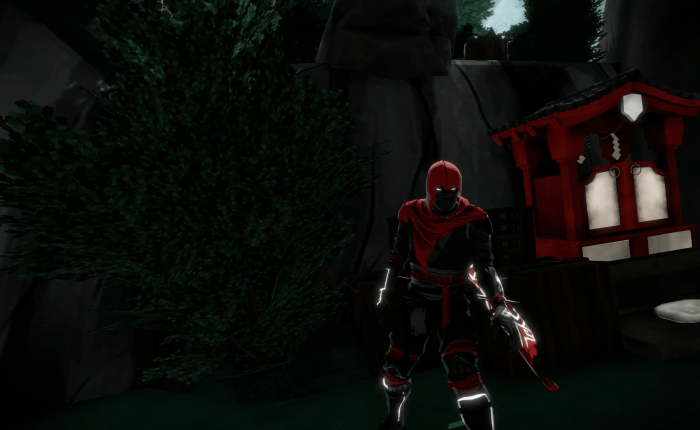
Now I’m into the normal game, and it looks absolutely beautiful. The environment, the main character, everything looks stylized and yet realistic at the same time.

The game drops me right into it and quickly walks through teaching me how to use my abilities. The game also teaches me about being in shadow and to avoid the light.

The way they shows me what buttons to use is really neat. There are giant tablets in the world that have the instructions written on them. Surprisingly, it feels quite natural.

The audio is interesting. The dialogue is in, I think, Japanese but it’s run through an audio filter so it sounds a little like characters are talking underwater. It reminds me of Okami. Of course there’s a lot about this game that reminds me of Okami, which I can only think is a good thing.

I finally got caught out, and discovered that not only do I die in a hit, but the soldiers with swords can use them to fire a wave of light to hit me from range.

After a little more trial and error, I found that once spotted I have a second or two to respond before an enemy either kills me or blows a horn to summon reinforcements.

Story

The character Aragami is a conjured shadow of vengence meant to exact death to the enemies of the princess and to free her from her confinement. One interesting thing about this setup is it completely bypasses the discussion about the morality of killing people. You were summoned to kill the Kaiho, the army of light, and so that is what you’re going to do. The story does go much deeper as you progress, but if I try to describe it then I’ll end up spoiling it.

The reversal of light and dark is also interesting since you are the creature of shadow and your enemies are the army of light. Even the gameplay supports this since shadows are good and light is bad.

Interface

Aragami is a beautiful game, and part of that is the lack of a UI for most of the game. Rather than have a HUD, the designers placed everything the player needs to know on Aragami’s cape, similar to Dead Space. For the most part this works well, though occasionally I had trouble seeing how many special ability charges I had whenever the cape got twisted up.

I wish the camera didn’t auto-rotate to point towards the objective when I push C to have Korasu show me the objectives. Often times I would bring up the indicators so that I could look for ability scrolls, which meant I first had to drag the camera away from the goal marker before I could look around me. They need to add the ability to toggle the auto-rotate off in the options menu.

I like that each of the special abilities has its own charges. This encourages players to make use of the more unique abilities since if they don’t then the charges will simply go to waste.

I found it strange that the game uses (at least on the computer) E for special and F for use. In most other games E is the use key and F is the special key (or melee key in most shooters). A number of times I found myself hitting E to use something, then had to take a moment to remember that F is use. Most of the time I had Kunai equipped so mistakenly hitting E didn’t cost me anything. But I could certainly see people wasting a special ability charge by mistake if they’re used to the keys being reversed. Unfortunately there’s no way to remap the controls.

I wish there was a way to know if I killed all of the guards in a level before I leave since that is one of the optional objectives. I ended one of the levels having missed two guards. I missed those last two guards not because I thought they would be too difficult, but simply because I didn’t know that I had passed by them.

Occasionally you’ll get a checkpoint right before a cutscene (instead of right after it), which is odd. But since you can skip cutscenes, it’s really just a minor annoyance.

Gameplay

Aragami is overpowered. The game goes out of its way to give you some insanely powerful abilities. Not only can you teleport around from shadow to shadow, but you can also create shadows almost anywhere and then teleport to that spot. And then there’s all of the other abilities like the kunai which is a ranged instant kill that never misses. Despite this, you are still going to get killed/spotted. The end result is that whenever you do fail, it absolutely feels like your own fault rather than the game doing something cheap. After all, with such powerful abilities, there should be no reason for you to fail. I feel like this is the real secret to the game that makes the gameplay feel so good.

My one big complaint with the game is that there’s aren’t enough checkpoints in the early levels. Each level is divided up into several areas. In a stealth game such as Aragami, each area is like a puzzle. You keep working at it, learning where enemies are, where they patrol, what areas you have access to, the best places to lure enemies to in order to take them out, until eventually you find the right combination of patience and action to solve the puzzle. The problem is, once you solve a puzzle, it becomes far less interesting having to solve it a second time. You would think that there would be a checkpoint after each area, but often you have to clear through two or even three areas before you reach a checkpoint. This can lead to a situation where you clear the first area, only to fail in the second area and thus have to re-clear the first area. Each time you have to re-clear an area, your enjoyment of that area goes down. The most times I had to clear an area was three times (meaning I died twice in the next area), but after the third time I honestly hated the first area since it took a while to clear and wasn’t interesting at all since I already knew exactly how to solve it. I would like to see the developers be a little more liberal with their checkpoints.

I feel like a lot of stealth games do this and yet every time I see it I cannot help but think it is a mistake. That is, they give the character the ability to go invisible. I feel like granting invisibility to players is a poor design decision because it allows them to go into a state where they no longer have to care about anything. The enemies stop being dangerous, players don’t care if they’re out in the open, and all around it undermines the very foundation of the game itself. Aragami is not the only game to fall into this trap. Deus Ex: Mankind Divided did the same thing, and that too I felt was a bad design decision. I tried out the stealth ability in Aragami and felt that it actually subtracted from the gameplay rather than enhanced it. After my test I decided to continue on as if the invisibility special ability didn’t exist, and I think I enjoyed the game more as a result. I personally would like to see this ability get removed completely. Though the designers would need to double check that each mission can be cleared without killing any enemies (one of the optional objectives) without the use of invisibility.

The ability to disappear corpses should be part of the base kit for Aragami. It’s one of those abilities that has such a massive impact on the game it seems like it’s too important to be considered optional. As for the ability itself, I do like that it doesn’t work on the corpses of enemies that die in direct light. It adds an extra bit of strategy to killing. Though once players gain access to the Shadow Kill special ability, they can use that instead since that ability does work in direct light.

Conclusion

You will like this game if you’re a fan of stealth games. The gameplay is solid, the levels are well laid out, and there’s a constant sense of danger as you go (so long as you play without using the invisibility special ability).

You will not like this game if you aren’t very patient and want a game with a lot of action. You spend a lot of time slinking around in the shadows, and if you get killed then you will have to repeat a bit to get back to where you were.

Aragami is an incredibly well made game. I know I’ve said this already but I can’t say enough about how beautiful the game is. The aesthetics make you want to explore the world, while the solid gameplay will make you truly feel like a master assassin. Aragami is one of those games that takes a core idea, stealth assassin, and successfully narrows down the mechanics to deliver a near perfect game.
Starbound Review

Starbound Review

The First 15

I found the character creator to be simple and yet fun. There wasn’t much, but it got the job done and made me feel like the character was one I chose.

The available difficulties are Casual, Survivor, and Hardcore. I chose the Survivor difficulty.

I like how in the story you are already late right from the start. It reminds me of The Journeyman Project (ten points if you’ve even heard of that game).  It probably isn’t intentional, but it was a nice nostalgia trip for me.

You get the Matter Converter right away and start using it immediately. Even this early I can tell that most of the game will revolve around the Matter Converter.

Strangely enough, I just got this super advanced piece of technology (the Matter Converter) and the next thing I get is a…sword. Not a beam weapon, not a phase pistol, not even a normal gun, a sword. And, the sword I get isn’t some futuristic weapon. It’s a metal sword. And somehow, it’s the only weapon I find during my escape.  From a gameplay perspective it makes sense that you start with a melee weapon, but the sharp disconnect when it comes to the lore of the game makes this interaction feel forced. It might make more sense if I got a piece of metal I grabbed from the rubble to use as an improvised weapon, but instead someone from this super advanced society took the time to create a really crappy sword that I just happened to find. This could have been handled better.

I arrive on my spaceship and find there is a cat already aboard. It’s a small decision by the designers to include a silent companion, but it’s a nice touch and adds a bit more personality to the game. The other “character” is the computer AI who likes to make very sarcastic remarks. For instance, “There is a 32% chance this discovery is important and a 98% chance that you have nothing better to do than investigate.” So far, I like the cast of characters they’ve put together for me to “work” with.

The very first thing I did upon arriving at the planet was try digging a hole into the earth using the Matter Converter. I got a little ways down and found a cavern with some enemies who killed me in short order. Alright then.

And that seemed a fitting end to my first 15 minutes of playtime.

Story

The opening of the story certainly gave me a sense of having just barely managed to escape something horrendous. My problem with the story is that very quickly the game explains exactly what is happening and you get recruited to defeat the ‘great evil’. In a game that’s supposed to be all about exploration and experimentation it seems odd that they would simply hand you the whole story right from the start without any sort of effort. The story itself is intriguing, but I feel that it would be even better if players had to piece it together themselves by exploring the various planets.

Interface and Controls

One thing I found very strange is that, as far as I could find, there is no way to pause the game. Pressing ESC brings up the menu, but it doesn’t pause the game in the background even if I’m only playing single player. There are a million and one reasons players might need to get up from their computer, and not allowing them to pause the game seems like a poor decision. Especially given that on the hardest difficulty dying is permanent.

One big oversight with the game is that the game only saves when you quit. What this means is that if the game crashes (which I will mention never happened to me) or the power goes out (which did happen to me) then you lose all of your progress since the last time you started the game. Eventually I got into the habit of quitting to the main menu and then re-entering the game every hour or so just in case. The game loads very quickly, so this wasn’t a huge annoyance, but it still felt weird not to have some sort of auto-save feature.

You can’t skip cutscenes. I would think that by 2016 developers know better than to have 5+ minute cutscenes with no way to skip them, but it would seem not. This is even more odd given that you do have the option to skip the opening segment of the game.

Gameplay

Early on I found myself getting hurt a lot, which obviously was a problem. However, this became much less of a problem once I figured out how to craft health kits. It’s a smart idea on the part of the designers to give players early and easy access to basic health recovery. It incentivizes players to explore the crafting system without requiring it (since it is possible to get good enough you stop getting hurt). Players who tinker with crafting are ultimately rewarded with health packs for their efforts. This interaction is perfectly designed and represents how a game like this should unfurl.

The lack of an overview map is annoying and makes it difficult to navigate the planet at times, especially from inside the earth.

My biggest complaint with the game relates to exploration and how it interacts with the different difficulty options. Digging into the planet is a fun experience. You never know if you’re going to find a vein of rare minerals or maybe drop into a cavern filled with monsters and treasure. The problem comes when you’re done having fun and want to return to the surface. On Survivor difficulty you cannot return to your ship unless you are standing on the planet’s surface. Meaning that if you dig down into the planet, you then have to dig all the way back to the surface which takes ages compared to how quickly you can burrow down. Also, if you happen to die on Survivor difficulty you lose everything you’ve gathered. This penalty seems more than a little absurdly harsh. And on Hardcore mode when you die you stay dead. On the flip side there is Casual in which you lose nothing for dying and can warp back to the ship from anywhere, including inside the planet. I noticed that exploration became infinitely more enjoyable when I could explore somewhere for as long as I liked, and then warp back once I was done rather than having to slog my way back to the surface. And of course there’s the risk of dying when I dig up into a chamber and get crushed by an avalanche of bones (true story) at which point I lose everything I gathered if I’m playing on Survivor. My issue is that there exists such a huge disparity between Casual and the other two difficulties. You have to chose between exploration being almost too easy, or it being a massive pain. There should be a middle difficulty between Casual and Survivor in which dying still carries a penalty, but doesn’t make you want to quit playing altogether. And as for exploring, there should be a system in place (and available the moment you set foot on your first planet) that allows you to quickly return to your ship in exchange for some amount of resources (such as Core Fragments which are found near the center of most planets). Given how much of the game is about the joy of exploring, they make it surprisingly difficult to actually enjoy exploration.

One of the big upsides to this game is that it supports modding. While I did not use any of the mods available I did take a look through what was available. Many of these mods add an absolutely staggering number of new items to the game while others subtly (or not so subtly) change the rules. There are mods that do things like add the hunger system to Casual difficulty or make it so you don’t lose items on Survivor difficulty when you die (though you still lose money). It is possible that there may be other mods that address other issues I have with this game. That said, this review is for the base version of the game as envisioned by the developers.

Conclusion

You will like this game if you enjoy getting sidetracked by exploring previously undiscovered areas and tinkering with a wide variety of craftable items. You can also build your own buildings and decorate/upgrade your spaceship.

You will not like this game if you want a high action game or one that guides from one action point to the next. While this game does have a core storyline it does a lot of meandering along the way. Much of this game is about finding your own fun.

Starbound is a solid foundation for a game. That said, there are a number of gameplay decisions that make things feel more frustrating than fun. Fortunately, with the assistance of some mods, many of those issues can be addressed rather easily.

Thank you for reading my review and I hope it provided you some real insight into Starbound. Please feel free to leave any remarks in the comments section below.